MJF — Interactive AI Portfolio
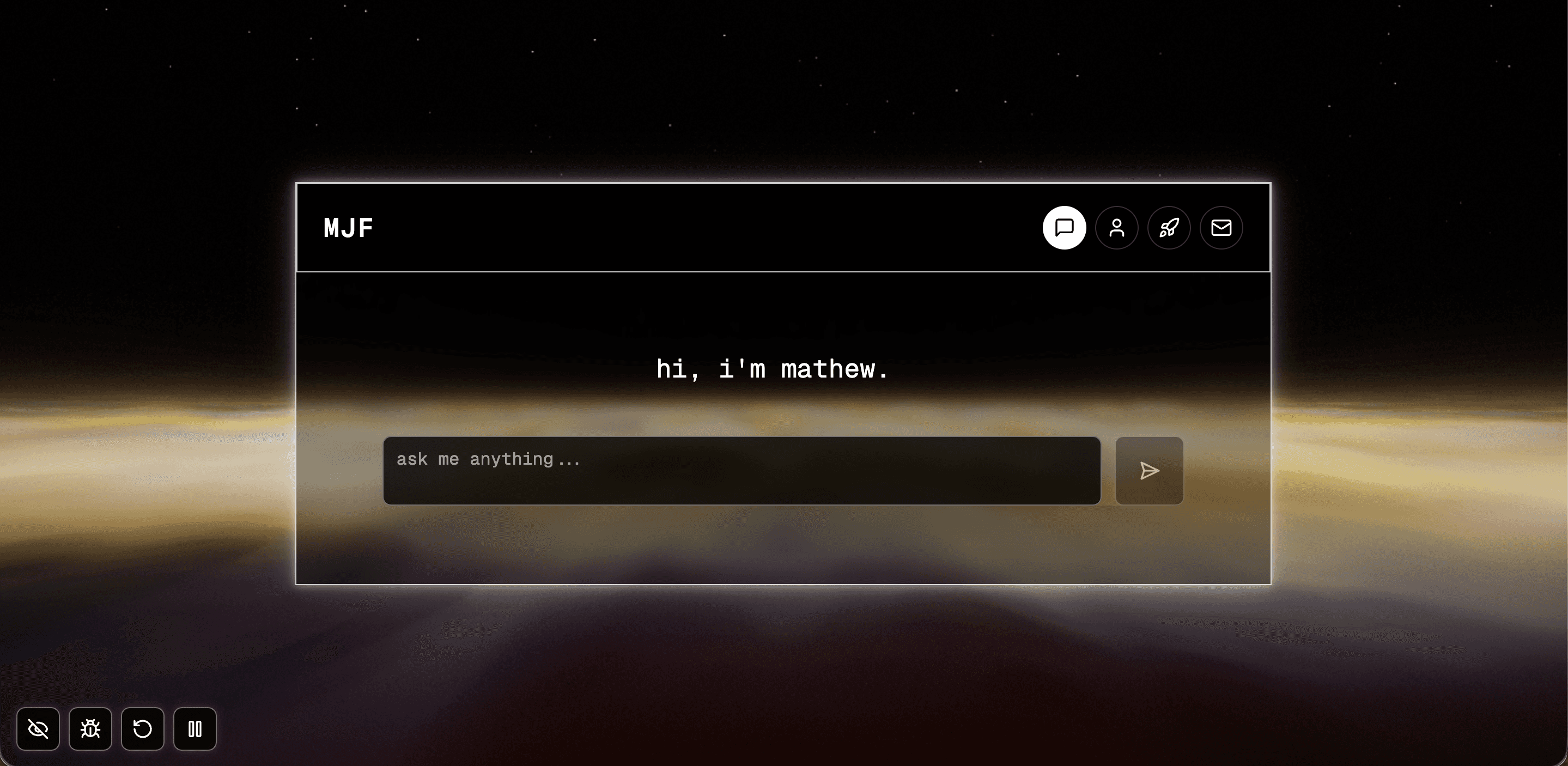
This website: hybrid retrieval, a source-backed AI guide, streamed responses, and a custom WebGL atmosphere.
About the project
I wanted a portfolio that someone could explore by browsing or by asking a question. The result is an interactive web application: project pages and personal context share a knowledge layer with a conversational interface. The custom visual environment gives it a sense of space, while reusable navigation and project components make the work easy to reach. The website is also a place to explore the engineering behind retrieval, response streaming and responsive interface motion.
What I built
- A custom WebGL2 raymarched atmosphere and cloud shader, with animation controls and timing diagnostics.
- A retrieval pipeline using curated profile and project records, keyword search and semantic embeddings.
- Streamed chat responses and project presentation within the conversation.
- Shared animated navigation, hover-aware typing, loading transitions and responsive layouts.
- A single project catalog that feeds cards, detail pages and generated chat knowledge.
- Reusable workspace packages for chat contracts, data access, orchestration, API and UI integration.
From a question to an answer
A browser sends the conversation to a Next.js server route. A planner chooses queries against project, résumé, or profile records. Project and résumé retrieval combine MiniSearch keyword matching with cosine similarity against stored OpenAI embeddings. The answer stage receives the selected evidence and streams its response and relevant project cards back through server-sent events. The current configuration uses gpt-4o-mini for planning and answers, text-embedding-3-small for embeddings, and retrieves six records by default with a maximum of eight per query.
Why the knowledge is bundled
The project catalog feeds both the visible pages and generated retrieval records. A sync script regenerates the records and embeddings after content changes. With a small, curated portfolio corpus, bundled JSON records and in-process vector comparisons keep the data layer simple; this version does not require a separate vector database or an AWS retrieval service. The tradeoff is that knowledge changes need regeneration and redeployment. A larger or frequently changing corpus would call for a different storage and indexing choice.
Grounding and honest limits
The assistant identifies itself as an AI guide and answers from published profile and project evidence. Its instructions distinguish implemented behavior, demos, prototypes, and goals, and require it to acknowledge missing facts. Only material suitable for the public portfolio belongs in its knowledge files. These instructions reduce unsupported answers; they do not guarantee correctness. Project cards let visitors inspect the material supporting an answer. An agent coordination interface is not automatically a RAG implementation, and simulated operations are not customer deployment evidence.
What a reviewer can verify
Ask the guide how this portfolio works, then compare the explanation with the published details here. For a deeper review, ask Mathew for a walkthrough of the search, orchestration, streaming, and content sync code. The repository includes conversation evaluation tooling and an API integration check for staged streaming events. Test tooling is not itself a measured accuracy result: this page does not claim a benchmark score, enterprise adoption, or production-scale load testing.
Motion with a purpose
The atmosphere uses real elapsed time to keep its motion consistent. Navigation springs, page loading states and the typing cycle make transitions legible without requiring the visitor to learn a different interaction on each page.